
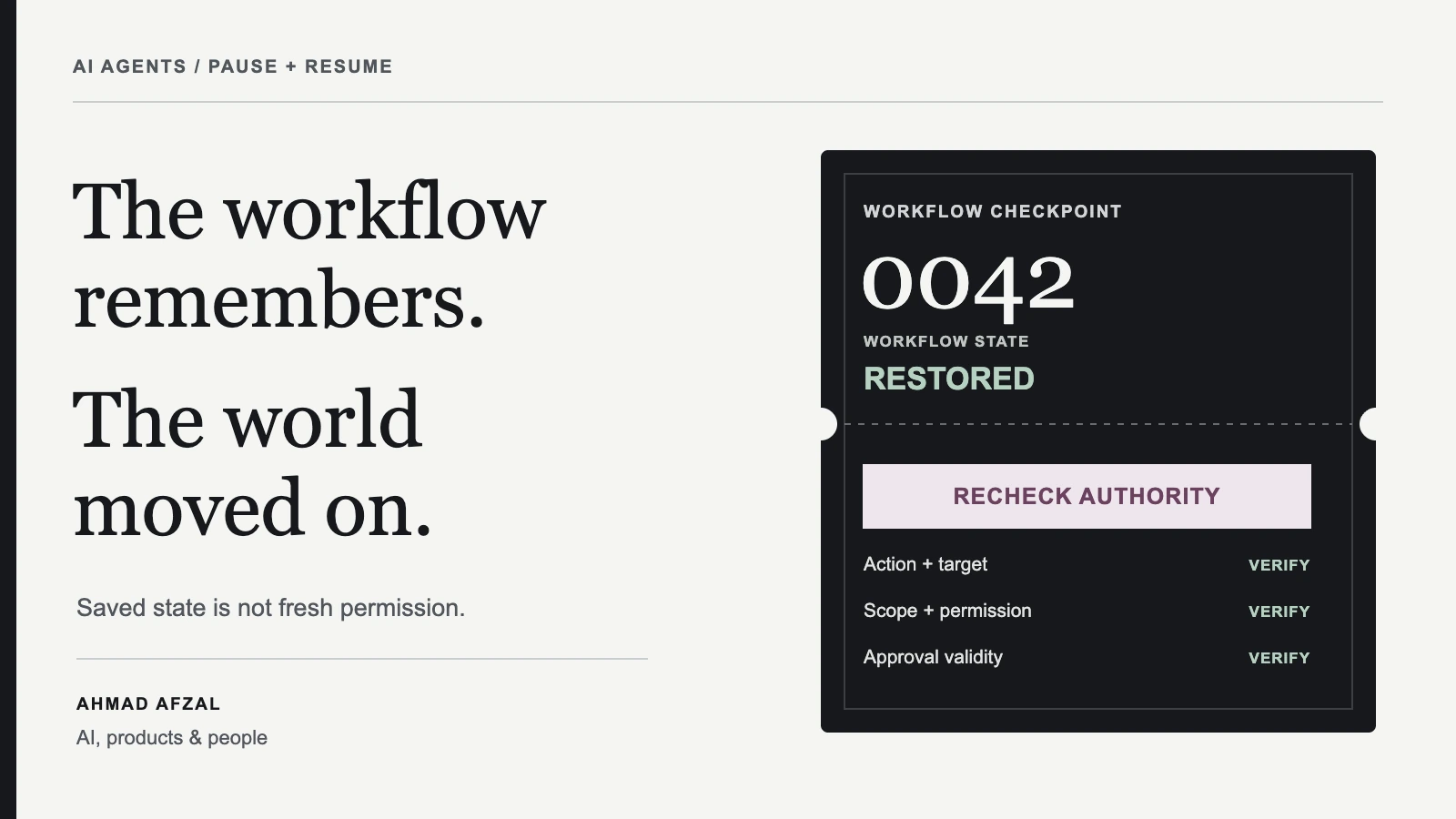
Pause a film, make tea, press play. Everyone is exactly where you left them. Lovely feature. Terrible assumption for an AI agent connected to a business.
While the agent waits for approval, somebody changes the record, removes a permission or completes the task another way. The checkpoint remembers the old conversation perfectly. The world has not signed an agreement to sit still.
Resuming AI agents safely means checking what remains valid before allowing the next write. Restoring execution state, confirming current authority and recovering an uncertain outcome are different jobs. A single “resume” button can hide all three.
Start with the pause you actually have
Imagine a support agent preparing to archive an inactive project workspace. This is an illustrative scenario. A reviewer approves the proposed action, but the worker stops before completion is recorded. Later, another team starts using the workspace. What should happen when the worker returns?
First establish where execution stopped. Waiting for a decision is different from holding an approved action that has not started. Both differ from having sent the archive request without receiving a reliable result. Store these states separately. “Incomplete” is too vague to decide whether to run something again.
LangGraph’s interrupt documentation makes an important distinction: resuming restarts the interrupted node from its beginning. Code before the interrupt runs again. That behaviour matters if the node sends a notification or modifies a record before asking for review. Check your framework’s actual replay boundary rather than assuming execution continues at the next line.
Keep preparation repeatable and place the consequential write after the approval boundary. That avoids repeating it merely because the interrupted node restarts, but does not solve crashes after a write. Persist the intended action before execution so a resumed worker can compare rather than quietly invent a replacement.
Restore the work, refresh the checks
Keep the original proposal and review decision available for comparison. Then retrieve the current facts needed for this action: the workspace identity and version, relevant policy, the acting principal’s permissions and the approval’s validity conditions. Avoid asking the model to remember whether access was allowed yesterday.
The OpenAI Agents SDK tools guide distinguishes making a tool available from authorising access to its arguments and target resource. A tool appearing in the restored conversation is therefore not sufficient evidence that this particular write remains permitted. OWASP’s excessive-agency guidance places authorisation in downstream systems and calls for validation of requests against security policies.
For our workspace, newly added activity should block the old archive proposal under the proposed policy. Show the reviewer what changed and prepare a new proposal if appropriate. If nothing relevant changed and the original approval remains valid, continue without demanding another ceremonial click. Humans have enough browser tabs already.
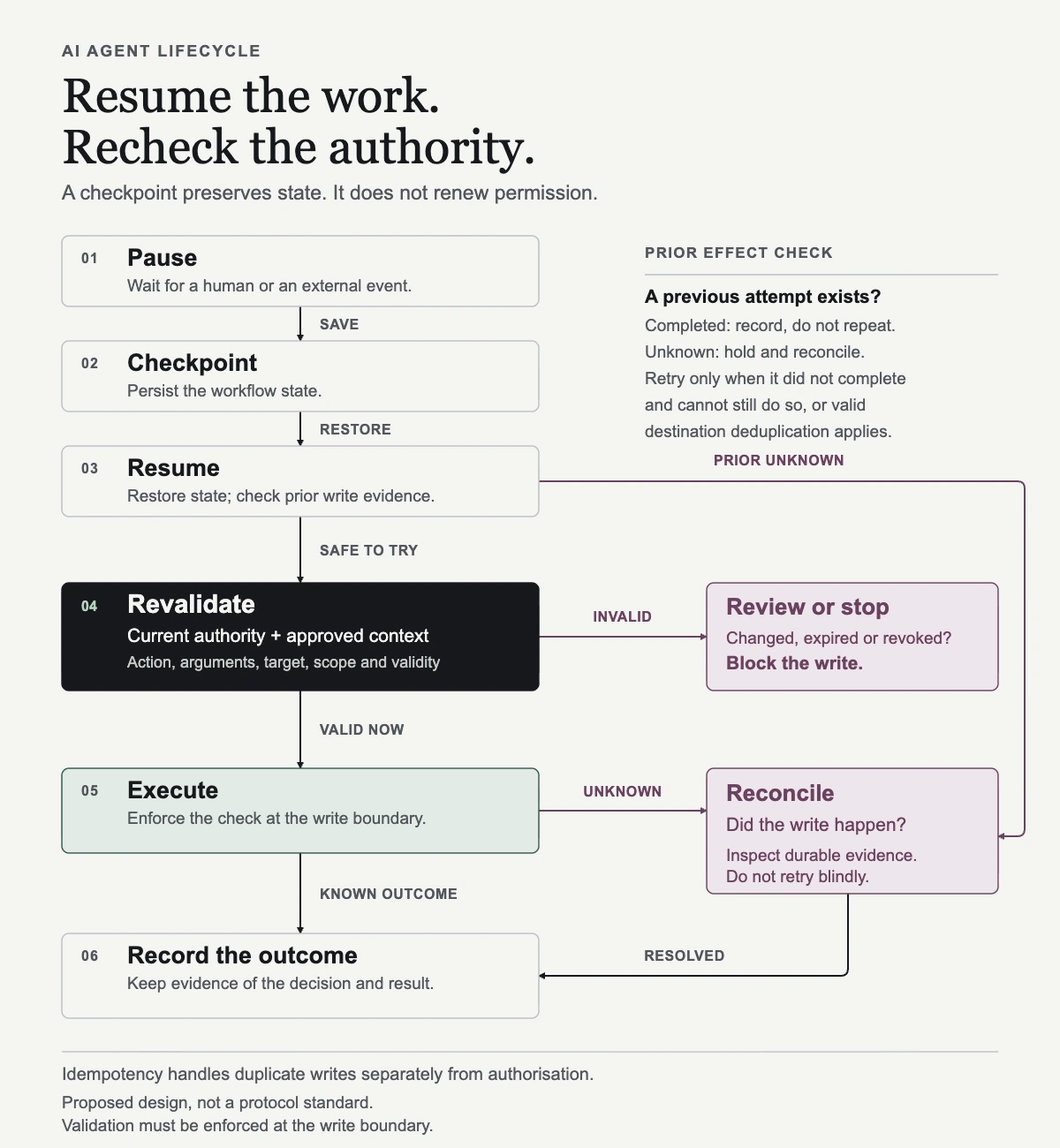
Put the check next to the write
A fresh read followed by an unconditional write still leaves a gap. Another worker could update the workspace between those operations. Where the destination supports it, use a conditional write against the resource version you checked, or an appropriate transaction. If the condition fails, stop and reassess.
Where that mechanism is unavailable, document the limitation and restrict the action accordingly. A second approval screen does not make a remote system atomic. The lifecycle diagram is a proposed implementation pattern, not a claim that a framework supplies all these controls automatically.
This complements versioning an AI release approval. Release review asks whether a particular system configuration is acceptable. Resume validation asks whether this pending action is still acceptable against the current target. Passing one does not settle the other.
Unknown is a state, not an invitation to retry
Suppose the archive request reached the service, but the worker crashed before saving its result. The checkpoint still looks unfinished. Replaying it blindly could repeat an action that already happened.
The OpenAI Agents SDK recovery guidance explicitly separates approval from exactly-once execution. For consequential actions, it recommends stable idempotency keys enforced by the destination. Reuse the same key and parameters for the same logical action within the destination’s supported rules. Generating a fresh key for every retry defeats that protection.
If safe deduplication is unavailable, reconcile with the destination before retrying. A missing local result does not establish failure, and a delayed read can miss an action still completing. Keep an uncertain outcome marked unknown. Without valid deduplication, retry only after authoritative reconciliation establishes that the earlier attempt neither completed nor can still complete. If it completed, record the result instead. Another person clicking “yes” cannot resolve missing execution evidence.
Test the return from lunch
Build a small test around the pause itself. Change the workspace while the agent waits. Revoke its access. Resume the same checkpoint twice. Simulate a successful write followed by a lost response. For each case, specify whether the expected result is execution, rejection, fresh review or reconciliation.
Record the checkpoint identifier, proposed action, validation result and destination receipt in the agent audit trail. Add failures to your agent evaluation suite. The useful demo is not merely an agent waking up. It is an agent noticing that something happened while it was asleep.