

By the third exhibition hall, I could guess the dashboard before I reached the stand.
I had been walking the floors at GISEC and AI Everything in the UAE. A giant glowing globe sat in the middle of screen after screen. Widgets orbited it. The gradients looked suspiciously well acquainted. Somewhere, a globe supplier was having an excellent quarter.
The work was competent. That was what bothered me. You could have swapped two screens and barely noticed. Taste in AI workflows matters precisely here: when several outputs are acceptable and someone still has to decide which deserves to exist.
AI monoculture has a research problem behind it
The Artificial Hivemind study examines repetition within models and similarity across them. In one example, responses from 25 models to a request for a metaphor about time clustered around familiar ideas, especially a river.
The paper reports cross-model sentence-embedding similarity of roughly 0.71 to 0.82 in its experiment. That measures semantic resemblance. It does not mean 82% of answers were identical, and it is not a universal score for every model or task. The causes of the convergence are also not fully established.
That distinction matters. My exhibition-floor observation is an anecdote, not a controlled experiment linking a particular dashboard to a particular model. Still, the research gives us a useful reason to question whether changing the model will automatically change the idea.
Taste starts where “good enough” stops helping
My working definition of taste is a consistent way of choosing between options that are all good enough.
A support dashboard can be beautifully rendered and terrible at helping someone find the next unresolved case. An agent can produce a polished explanation that answers a question nobody asked. Competence gets the output through the door. Judgement decides whether it belongs in the room.
This connects to why evals are part of the product. We need evidence that a workflow works, then criteria for choosing between versions that meet that threshold. A preference for restrained typography cannot excuse a broken permission boundary. The practical checks in AI change control still apply.
Write the preferences down
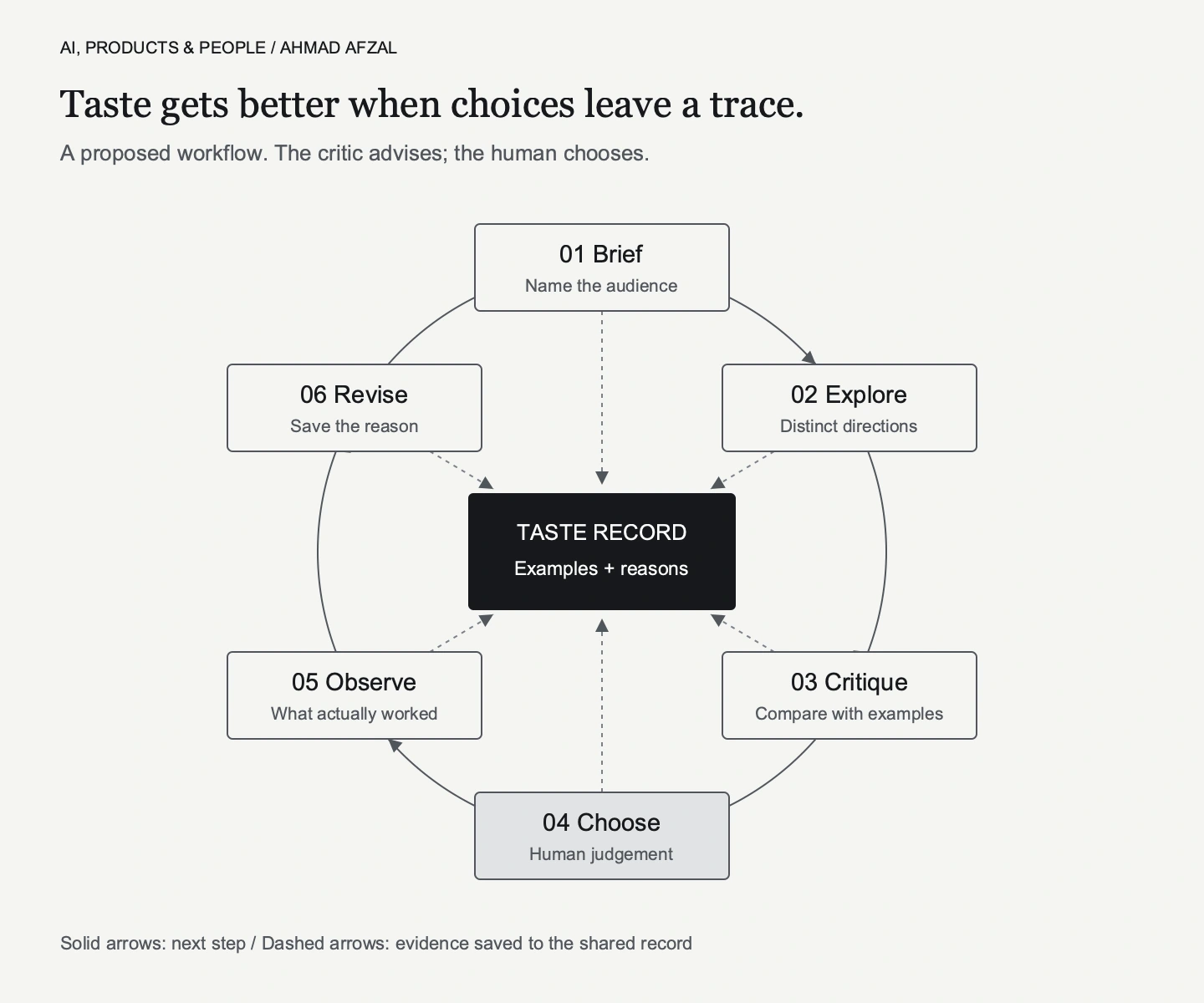
I keep my own taste profile as a skill, alongside a pre-flight checklist my agents run before anything ships. The useful part is making a preference available at the moment a choice happens.
“Make it premium” gives an agent a mood. An annotated example gives it something to inspect. I would rather specify that the first screen should reveal the user’s next decision, that decorative visualisations need a purpose, and that a claim needs evidence. If the globe explains global routing, fine. If it is there because the design got nervous about empty space, it can go.
Keep examples you rejected as well as examples you liked. Add the reason. Otherwise, the system learns that one layout won without learning what problem it solved.
Ask for range, then make a choice
Five versions of the same idea are one option wearing five jackets. Ask for different organising principles: a decision queue, a timeline, a comparison, a map where geography actually matters. Require each proposal to explain its trade-off.
Verbalized Sampling explores prompting models to provide multiple responses with probabilities and reports improved diversity in its tested settings. That is an interesting technique to try. The model’s stated probabilities should not be treated as calibrated confidence, and a more unusual answer still needs to be useful.
A separate critic can compare the candidates against your examples. Ask it to point to the evidence for its judgement. Keep deterministic checks for deterministic rules, such as missing sources or prohibited phrases. A critic’s score is advice, not a certificate of taste.
Save the tiebreaker
After choosing, record what won, what lost and why. Then check what happened when someone used the result. A preference that keeps producing confusion needs revising, however attached you are to it.
This is the part I care about most. People forget the problem they wanted to solve and start relying on AI to do the deciding too. The workflow should make our judgement more deliberate. It should leave us able to explain the choice.
An agent’s taste is whatever wins the tie. Set the tiebreaker, or the average will.
Watch the original video
The video below accompanies my original LinkedIn post. The similarity figure discussed above clarifies the shorthand used in that post.